
The Human Being as a Divine Organism and Three Dimensional Justice
Adrian Ashley Toader-Williams presents Umaniterra’s philosophy of three dimensional justice, the Deoclavis matrix, forgiveness and regeneration.

Reconstructing Freemasonry through the Three Pan Balance and the Deoclavis Divine Matrix in the Vision of the Umaniterra Masonic Order
Author details supplied with the original
Dr. Adrian Ashley Toader-Williams, Ph.D. 3-33-66-98-99-100
Member of the International Academy of Sciences
Founding Grand Master of the Umaniterra Masonic Order (U M A N I T E R R A), International, Romania
Lieutenant Grand Commander, Suprême Conseil d’Occitanie
Lieutenant Grand Commander, Suprême Conseil d’Occitanie France et d’Umaniterra Roumanie
Editorial note: This translated essay presents the author’s philosophical and initiatory perspective within Umaniterra. Its interpretations of history and ritual express that perspective, rather than a position shared by all Masonic bodies. The author’s titles and credentials are reproduced as supplied.
Abstract
This extensive study examines the Umaniterra Masonic Order’s (O:.M:.U:.) understanding of the human being as a divine organism, of “Justice for the Third Millennium”, symbolised by the Three Pan Balance (B3T), and of the Divine Matrix, the Deoclavis Key, with its nine fundamental egregores. The article explores fidelity, betrayal, forgiveness and regeneration along the initiatory path, meritocracy in the degrees, the reform of Romanian Freemasonry, agriculture’s role as the first Masonic work, sacred anthropology and the need for a Constitution for the Third Millennium. Drawing on quotations from Umaniterra’s Declaration of Principles and the philosophy of O:.M:.U:., it offers a coherent vision of Freemasonry responsive to its times and to Romanian culture, while addressing contemporary challenges.
1. Introduction: the human being as a divine organism and a new initiatory paradigm
In the vision of the Umaniterra Masonic Order, the human being is more than a rational or moral being: a living divine organism, an embodiment and concrete expression of the Great Architect of the Universe. This sacred anthropology redefines the entire initiatory journey and establishes a new paradigm of responsibility, merit and justice.
The Declaration of Principles states explicitly: “Umaniterra recognises in the human being a divine being, endowed with freedom, dignity and cosmic responsibility.”
This vision is ontological, not metaphorical: the human being is a manifestation of divinity on the material plane, a builder of their own existence and a cocreator of the world.
Within this framework, Umaniterra proposes a profound reform of Freemasonry for the Third Millennium. Three Dimensional Justice, symbolised by the Three Pan Balance (B3T), and the Divine Matrix, the Deoclavis Key, with its nine egregores, become fundamental instruments for understanding fidelity, betrayal, responsibility and regeneration.
2. Umaniterra’s anthropological foundation: the human being as an embodiment of divinity
2.1. Sacred anthropology
Umaniterra begins with the premise that the human being is an incarnate divine being, a microcosm reflecting the macrocosm. This vision differs from symbolic interpretations of Western Freemasonry by proposing an ontological approach: humanity does not merely imitate divinity, but embodies it.
This perspective entails:
- heightened moral responsibility;
- awareness of one’s role as a cocreator;
- commitment to an ethic of care for the planet;
- understanding betrayal as a rupture with the sacred;
- cultivating virtues as acts of respect for and recognition of what and who one is, while maintaining a connection with divinity.
The Declaration of Principles emphasises:
“The human being is called to manifest their divine nature through deeds, not merely through words.”
2.2. Agriculture as the first Masonic work
In Umaniterra’s philosophy, agriculture is regarded as humanity’s first work of construction. Just as the Great Architect created the plant kingdom and then the animal kingdom, humanity continues creation by cultivating the land and raising animals.
Agriculture thus becomes:
- an act of cocreation;
- a sacred responsibility;
- an expression of the law of sowing and reaping;
- the foundation of meritocracy in the first degree.
Ancient civilisations, such as Egypt, understood this truth, and Umaniterra restores it to the centre of initiation.
3. The Three Pan Balance: Justice for the Third Millennium
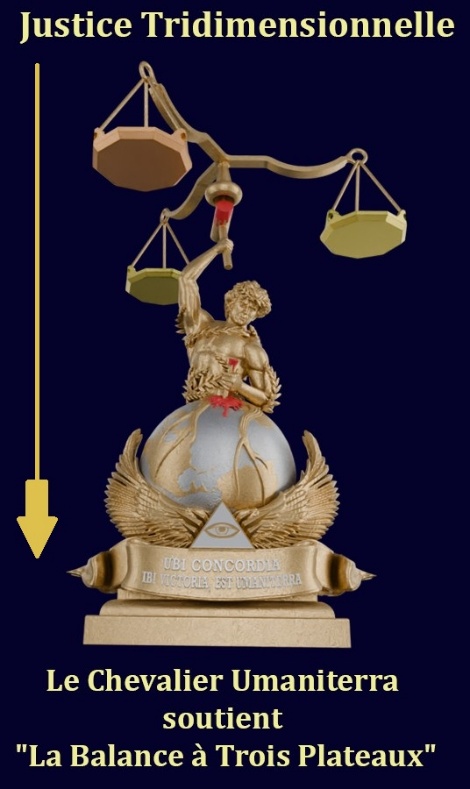
Original illustration. Its French legend reads: “Three Dimensional Justice. The Umaniterra Knight supports the Three Pan Balance.”
3.1. Why two pans are no longer sufficient
For more than 3,700 years, humanity has used a model of justice with two pans: facts and law. Umaniterra argues that this model is incomplete because it overlooks the spiritual, moral and ontological dimensions of judgement. To better understand the significance of the pans and how the Three Pan Balance operates as a model of thought, see Figure 1.
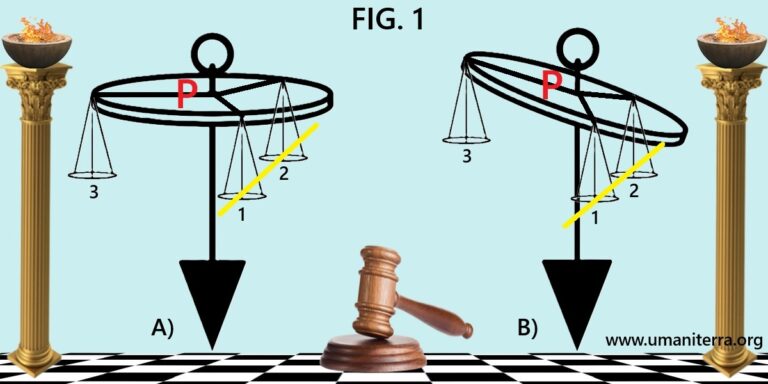
Figure 1. The Three Pan Balance, shown in configurations A and B in the original document.
3.2. The three pans of Three Dimensional Justice
- The Pan of Facts: objective reality.
- The Pan of Law: norms, rules and traditions.
- The Divine Pan: love, wisdom, compassion and spiritual truth.
Justice for the Third Millennium cannot function without this third pan, which restores balance to the first two and introduces a higher moral dimension.
3.3. Initiatory meritocracy
Umaniterra rejects the tradition according to which the degree of Master Mason is conferred simply because the petitioner has not been proven guilty of Hiram’s murder. This mentality, “if you are not caught, you are promoted”, has generated corruption, deviant behaviour and the moral deterioration of Freemasonry.
In its place, Umaniterra introduces:
- The degree of Meritocratic Apprentice: understanding the law of sowing.
- The degree of Meritocratic Fellow Craft: understanding the Level of the Horizontal Plane (NPO, the Romanian abbreviation).
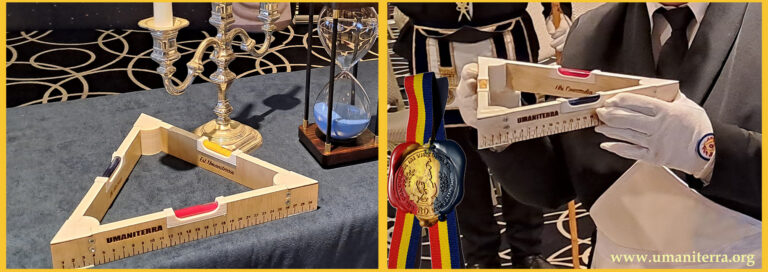
The instrument illustrating the Level of the Horizontal Plane (NPO) in the original document.
- The degree of Meritocratic Master: understanding and applying B3T.
This meritocracy is a form of three dimensional justice applied to initiation.
4. Betrayal and forgiveness along the initiatory path
4.1. The libation cup: a symbol of bitterness
The libation cup reminds the initiate that a broken promise leaves profound bitterness:
“May this drink, now bitter, be for you a symbol of bitterness and remorse…”
This bitterness has an educational purpose: it shows that the path of virtue is difficult and strewn with disappointments.
4.2. Betrayal as a psychological and spiritual phenomenon
Betrayal results from:
- envy;
- ambition;
- thirst for power;
- fear;
- a desire for emancipation;
- a misunderstanding of the initiatory role.
The betrayer abandons the sacred and falls into the profane. The element of surprise intensifies the betrayal, revealing the individual’s true nature.
4.3. Forgiveness as an act of regeneration
If betrayal is the greatest disappointment, forgiveness is the greatest effort. It is an act of transcendence, not weakness. Forgiveness regenerates, restores balance and makes spiritual development possible.
5. The Divine Matrix, the Deoclavis Key and the nine egregores
The Deoclavis Key represents the subtle architecture of reality. Its nine egregores are the principles governing the dynamics of fidelity, betrayal and regeneration.
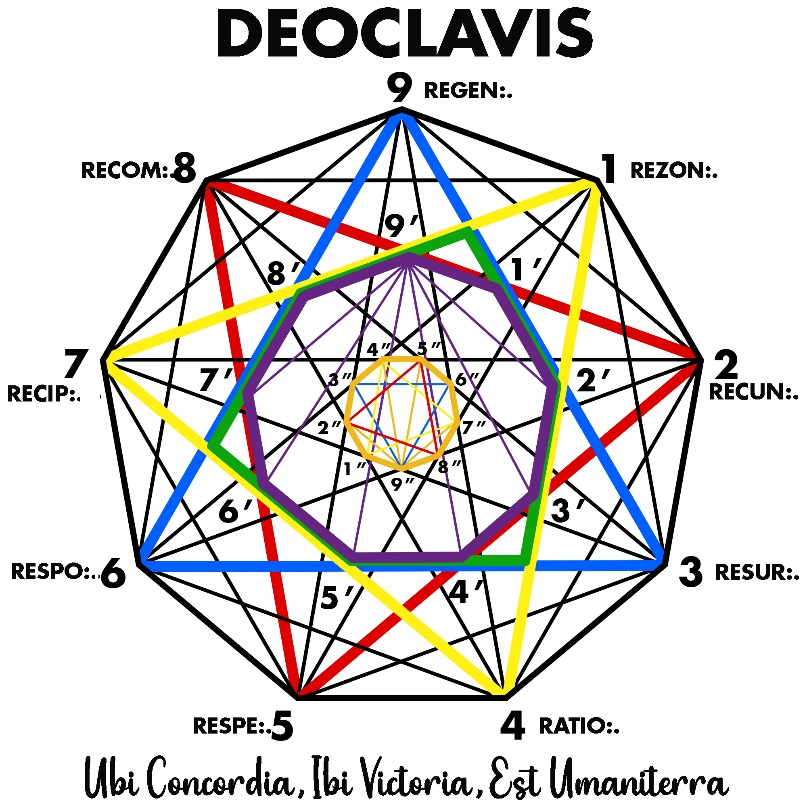
The original Deoclavis diagram retains its Romanian abbreviations. The nine principles are translated below in the same numbered order.
5.1. Resonance
Fidelity creates harmony; betrayal produces dissonance.
5.2. Recognition
Recognising another person’s worth is the foundation of fraternity.
5.3. Resources
Moral resources are tested in moments of disappointment.
5.4. Reason
Reason tempers the impulses of the ego and clarifies ambiguous situations.
5.5. Respect
Respect is the minimum condition for any sacred relationship.
5.6. Responsibility
Each brother is responsible for the consequences of his actions.
5.7. Reciprocity
Fidelity is a balanced exchange; betrayal breaks it.
5.8. Reward
The reward of fidelity is spiritual growth; that of betrayal is bitterness.
5.9. Regeneration
Regeneration is possible only through forgiveness and reform.
6. The reform of Romanian Freemasonry: a historical necessity
6.1. Romanian identity within Freemasonry
Umaniterra proposes a Freemasonry that is:
- adapted to Romanian culture;
- rooted in Christian Orthodox spirituality;
- open to pre-Christian mythology;
- connected to universal values.
6.2. A Constitution for the Third Millennium
A modern constitution must be:
- flexible;
- adaptable;
- connected to social realities;
- directed towards the common good;
- consistent with Umaniterra’s Declaration of Principles.
6.3. Initiatory collaboration in Romania
Umaniterra proposes collaboration with:
- other Romanian initiatory orders;
- academic institutions;
- spiritual communities.
6.4. Publications and research
The Order supports:
- initiatory journals;
- scientific works;
- studies in social psychology;
- analyses of three dimensional justice.
Umaniterra’s representation of the Three Pan Balance, reproduced from the original document.
7. Extended conclusion: humanity, justice and regeneration in Umaniterra’s vision
In the light of the principles of the Umaniterra Masonic Order, fidelity, betrayal, forgiveness and regeneration are more than moral concepts. They are fundamental initiatory processes defining the development of the human being as a divine organism. The Three Pan Balance offers a three dimensional model of justice in which the divine dimension complements and transcends the factual and normative dimensions. The Divine Matrix, the Deoclavis Key, explains the subtle mechanisms through which fidelity is built, betrayal manifests itself and forgiveness regenerates.
The reform of Romanian Freemasonry proposed by Umaniterra is more than an administrative necessity. It is an ontological reconstruction, a return to the sacred, to cultural identity and to humanity’s cosmic responsibility. In a world marked by moral, social and ecological crises, Umaniterra recalls that the human being is divine and that human conduct must reflect this reality.
Ultimately, the initiate discovers that true victory lies not in the absence of betrayal, but in the capacity to remain faithful to the light, to forgive, to regenerate and to contribute to universal harmony. Justice for the Third Millennium is a justice of balance, responsibility and love, rather than punishment. And the human being, as a divine organism, is called to be the architect of their own transformation and a cocreator of a better world. I have spoken!