Study
The Eagle with Two Heads
What does the Scottish Rite eagle represent? Guido Mond explores its symbolism, the responsibilities of Supreme Councils, the practice of ritual and the border lodges connecting Bratislava with Vienna’s Masonic history.
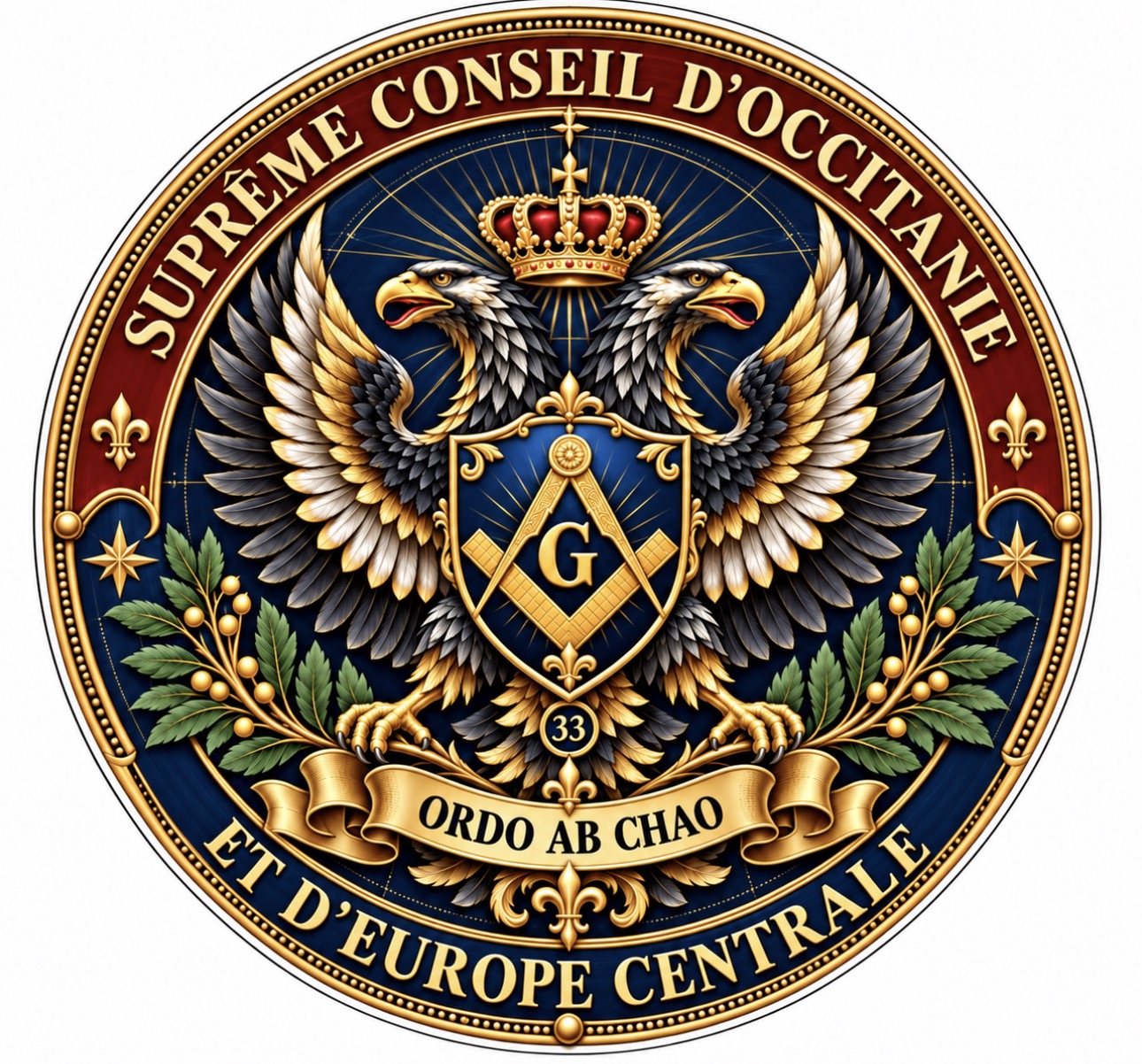
The double headed eagle is an established emblem of Scottish Rite Freemasonry. It appears in different forms in the insignia of the 32nd and 33rd degrees. Its use extends beyond a single degree or jurisdiction. 1
Two heads look towards different horizons. One body holds them together.
For the work joining Occitania and Central Europe, that image offers a demanding reflection: how can we preserve an inheritance while remaining attentive to the world before us? How can conviction coexist with humility, authority with restraint, and contemplation with action?
These are the questions through which this essay approaches the eagle. The interpretation offered here is a philosophical reading, rather than a claim that every Scottish Rite jurisdiction assigns the emblem one identical meaning.
At its centre stands the familiar motto Ordo ab Chao: order out of chaos. In the life of an institution, as in the life of a person, such order must be made through patient work.
What is the Ancient and Accepted Scottish Rite?
The Ancient and Accepted Scottish Rite is a system of Masonic degrees that develops the ethical and philosophical teachings introduced in Craft Freemasonry. Its subjects include duty, justice, fidelity, conscience and the obligations of human fellowship.
The foundational degrees are Entered Apprentice, Fellowcraft and Master Mason. The Scottish Rite extends their study through further degrees, with arrangements that differ between jurisdictions. The Supreme Council for Scotland, for example, recognises its Grand Lodge’s authority over the three symbolic degrees. This is a jurisdictional example, not a statement of Occitania’s administrative arrangements. 2
The numbering requires care. A sequence of degrees is a framework for study and responsibility. It provides no reliable measure of a person’s wisdom, character or conduct.
A member may remember a ceremony perfectly and still struggle to practise its simplest lesson. The real examination continues after the meeting ends.
This essay is offered in respect for that work wherever it is sincerely undertaken. Different Masonic traditions have different constitutions, spiritual requirements and rules of recognition. Those differences deserve accurate description.
From French high degrees to Charleston
The Scottish Rite developed through a history of exchange.
Its immediate background lies substantially in the high degree systems that flourished in eighteenth century France. In 1761, Stephen Morin received authority to carry Masonic work across the Atlantic. A system of twenty five degrees subsequently circulated through the Caribbean and North America. The name “Scottish” reflects the vocabulary of Écossais Masonry; it does not establish that the complete Rite originated in Scotland. 3
That French development also had earlier British antecedents. The Southern Jurisdiction’s historical account identifies references to Scottish forms of high degree Masonry in Britain before their expansion in France.
The decisive institutional milestone came on 31 May 1801, when the first Supreme Council of the 33rd degree opened in Charleston, South Carolina. In 1804, Alexandre Auguste de Grasse Tilly, a member of the Charleston Council, organised a Supreme Council in France. 4
The journey was circular as well as outward: European materials crossed the Atlantic, developed within new institutions, and returned to Europe in an altered form.
Tradition and historical evidence
The Grand Constitutions associated with 1786 occupy an important place in the Rite’s constitutional tradition. Their attribution to Frederick the Great of Prussia requires historical caution. The Southern Jurisdiction’s account treats that attribution cautiously and identifies its earliest known copy as dating from approximately 1801 or 1802. 4
This distinction strengthens serious Masonic study. A text’s role within an institution and the evidence for the story of its composition are separate questions.
We can respect a tradition while examining its sources. Fidelity to truth requires precisely that willingness.
Why a Supreme Council exists
A Supreme Council is a governing body within its Scottish Rite jurisdiction. Its responsibilities concern the administration and transmission of the degrees under its authority.
The ethical meaning of that responsibility deserves as much attention as its formal description.
A Council must ask whether its officers understand the work they transmit, whether records are reliable, whether instruction is serious, and whether authority is exercised within the limits of its constitution. Institutional continuity depends on these ordinary disciplines.
The 33rd degree must also be distinguished from membership of the governing Council. In the Southern Jurisdiction of the United States, an Inspector General Honorary holds the degree without being an active member of the Supreme Council. 5
The distinction is instructive. A degree, an office and a constitutional power are different things.
For us, the proper ambition of governance is to make the work dependable: to preserve what has been entrusted, explain what is required, and prepare others to carry responsibility in their turn.
How the thirty three degrees are organised
The Scottish Rite has a recognisable structure, but the names and groupings of its bodies vary.
For comparison, the Southern Jurisdiction of the United States groups the degrees into a Lodge of Perfection, 4th to 14th; a Chapter of Rose Croix, 15th to 18th; a Council of Kadosh, 19th to 30th; and a Consistory, 31st and 32nd. These groupings support study of fidelity, ethics, philosophy, chivalry and responsibility. 6
The Northern Masonic Jurisdiction separates the 15th and 16th degrees into a Council of Princes of Jerusalem and places the 19th through 32nd in a Consistory. 7
These examples illustrate variation. They are not an administrative chart for our Council. Each body must follow its own authorised constitution and ritual framework.
French terminology includes the Loge de Perfection, Chapitre and Aréopage. Occitania’s published programme names the Jean Moulin Lodge of Perfection, the Fernand de Magellan Chapter and the Molière Areopagus in its Toulouse work. 8
Beyond these administrative differences lies a question that every degree can renew: what does the teaching require of the person who receives it?
Progress becomes meaningful when instruction changes the quality of attention, judgment and action.
What ritual asks of us
Ritual gives ideas a form that can be encountered repeatedly. Scottish Rite public descriptions explain that degrees use dramatic storytelling and allegory to encourage ethical reflection. 7
For the purposes of this essay, ritual can be understood as a discipline of attention.
Attention to words
Careful language asks us to slow down. A promise spoken deliberately exposes the distance between what we wish to be and what we are prepared to do. The question follows us outside the meeting: will our ordinary speech carry the same care?
Attention to silence
Silence makes room for another person. Listening requires the temporary suspension of our wish to answer, correct or display knowledge. We begin to hear more accurately when we cease preparing our own performance.
Attention to symbols
A symbol gives thought something to return to. Consider the square as an invitation to examine fairness. Its relevance becomes concrete when we ask whether we apply the same standard to a friend and a stranger, or to our own conduct and someone else’s.
The tool remains simple. The examination becomes more difficult.
Attention through repetition
Repeated work creates an opportunity to notice changes in ourselves. A lesson about patience may seem obvious until circumstances make patience costly. Fidelity becomes sharper after disappointment. The familiar form meets a different person each time.
Ceremony alone guarantees nothing. Its value depends on the honesty brought to it and the conduct that follows.
The spirit of the Occitan tradition
The official presentation of the Grande Loge Nationale des Rites Maçonniques and the Suprême Conseil d’Occitanie describes a gradual spiritual path expressed through work upon oneself, fraternity and symbolism, within a Judeo Christian and chivalric spirit. It also welcomes visiting Sisters and Brothers from different obediences. 9
Occitania’s admissions page expressly requires belief in a Creative Principle and adherence to Judeo Christian values. It states that political and societal discussions are excluded from its work in order to concentrate on each person’s spiritual development. These are that institution’s published positions, not requirements attributed here to every Masonic tradition. 10
These terms deserve thoughtful interpretation. A spiritual orientation calls the individual to examine the purposes governing life. It asks what deserves loyalty, what limits ambition, and what gives an obligation its force when fulfilling it becomes inconvenient.
A chivalric ethic places strength under discipline. Its practical questions concern the protection of dignity, fidelity to a promise, courage before injustice and restraint when one possesses an advantage.
Fraternity must become visible in behaviour. It requires discretion with another person’s confidence, patience during disagreement, and assistance that preserves the recipient’s dignity.
An applicant to a Central European body should consult that body’s own admission conditions. Respect begins with clarity about the house one proposes to enter.
Toulouse and Central Europe: a contemporary connection
The official Occitania website identifies Christian Belloc as Sovereign Grand Commander of the Suprême Conseil d’Occitanie. It also links to the Suprême Conseil d’Occitanie et d’Europe Centrale. This is a public institutional reference for the connection presented on our website. 11
The scope of a particular agreement is expressed through that agreement. A public link, a collaboration, membership of an international institution and recognition by another jurisdiction each describe a different relationship.
For our work centred on Bratislava, with meetings also in Vienna, the connection with Toulouse presents a practical responsibility. We must communicate clearly across languages, keep documents consistent, and ensure that the same institutional commitments are understood wherever the work takes place.
Translation is part of that responsibility. A constitution, an explanation of membership or a statement of institutional status should retain its meaning in another language.
A fraternity extending across borders needs more than shared emblems. It needs the patient accuracy through which trust becomes possible.
Why Bratislava matters in Masonic history
Bratislava’s place in this story is supported by a revealing chapter of Central European history.
After the Austro Hungarian settlement of 1867, the two halves of the monarchy had different rules governing associations. Lodges could operate in the Hungarian half while restrictions remained in the Austrian half.
Viennese Freemasons gathered in associations at home and conducted ritual work across the internal frontier in the border lodges, or Grenzlogen. According to the Grand Lodge of Austria, fourteen existed by the outbreak of the First World War, working mainly in Pressburg, today’s Bratislava. 12
Humanitas was the first. The Grand Lodge’s anniversary account places its beginnings in 1871 and 1872 and describes how the border lodges moved to Vienna after the monarchy’s collapse in 1918, forming a Grand Lodge there. 13
The geography carries an enduring lesson. A frontier that restricted one part of life also provided a route through which another part could continue.
This history gives contemporary work in Bratislava and Vienna a meaningful setting. It does not establish an institutional lineage between those historical lodges and a present Council. Its relevance is the example of persistence, cooperation and responsibility across borders.
The destruction of Austrian Masonic life under National Socialism makes that inheritance still more serious. The Grand Lodge of Austria records the suppression of the lodges in 1938, exile and the murder of more than a hundred members in concentration camps. 12
Remembrance should deepen the care with which we use words such as liberty, dignity and fraternity.
The eagle in Central European memory
The eagle with two heads also belongs to Central Europe’s historical landscape. It became closely associated with Habsburg imperial authority. The World of the Habsburgs explains how imperial imagery was carried into the Austrian Empire following the dissolution of the Holy Roman Empire in 1806. 14
Its presence in imperial heraldry and Scottish Rite symbolism invites comparison while leaving their histories and meanings distinct.
Here, I propose a personal ethical reading. One head can remind us to look towards what we have received: the texts, obligations and experience of those before us. The other can remind us to look towards the consequences of what we are doing now.
The shared body asks for coherence. Knowledge should inform action. Conviction should remain open to examination. Memory should help us make better judgments in circumstances our predecessors could not have anticipated.
For an institution connecting Toulouse with Central Europe, the emblem can express a similar obligation. Different languages and local experiences must be held within a common standard of conduct.
The unity worth seeking can sustain difference without losing its commitments.
Ordo ab Chao: the work of creating order
Ordo ab Chao means “order out of chaos” and appears within the Scottish Rite’s historical symbolism. 15
As an ethical principle, it begins close to home. We encounter disorder when we confuse information with understanding, impatience with decisiveness, loyalty with indulgence, or authority with personal entitlement.
We begin to create order when we distinguish a fact from an assumption, accept a correction, keep an accurate record, or resolve a disagreement without humiliating the other person.
The same discipline applies to institutions. Responsibilities should be understood. Decisions should have a clear basis. Documents should agree with public statements. Promises should be proportionate to what can actually be delivered.
These practices may appear modest beside the grandeur of an emblem. They are the conditions under which its meaning becomes credible.
An institution earns trust through the consistency of its conduct.
Brotherhood as a practice
Fraternity becomes most visible when agreement is difficult. It asks whether we can hear criticism without treating it as betrayal, preserve another person’s dignity while correcting an error, and acknowledge our own mistake without searching for someone else to carry it.
It also asks how we behave towards people who can offer us nothing. Courtesy towards the influential is easy. Attention to the overlooked reveals more.
Within our work, brotherhood should mean a willingness to help another person become more capable, responsible and free in judgment. It should encourage honest questions and make room for those still learning.
The quality of a Council will ultimately be reflected in the quality of these relationships.
To the person who knocks
A serious enquiry begins with understanding. The prospective member should learn which institution they are approaching, what it teaches, what it requires and how it governs itself. The institution, in turn, should answer clearly.
Visiting members should establish the host body’s conditions and the rules applicable within their own obedience before attending. A sincere welcome and a clear rule can coexist.
For those already engaged in the work, the task remains demanding in its simplicity: study carefully, speak truthfully, keep faith with obligations, and leave the institution more dependable than we found it.
The eagle turns towards two horizons. We stand between what has been entrusted to us and what we will entrust to others.
The Work is handed on through the way we live it.
Ordo ab Chao.
Questions about the Scottish Rite and its eagle
What does the double headed eagle mean in Scottish Rite Freemasonry?
It is an established Scottish Rite emblem. Here, its two heads invite reflection on the relationship between thought and action. This is an interpretation, not a universal doctrinal definition. 1
Did the Scottish Rite originate in Scotland?
Its development involved earlier high degrees, substantial growth in France, transmission through the Caribbean and North America, and the first Supreme Council in Charleston in 1801. 34
Does every 33rd degree Mason belong to a Supreme Council?
No. Holding the degree and occupying a governing seat are distinct, as the Southern Jurisdiction’s distinction between honorary and active Inspectors General illustrates. 5
Are Scottish Rite degrees organised identically everywhere?
No. The names, groupings and administration of degree bodies vary by jurisdiction. Local constitutions and authorised rituals govern their actual operation. 67
Why is Bratislava important to Central European Masonic history?
Viennese Freemasons conducted ritual work across the frontier when Austrian restrictions prevented it at home. Many border lodges worked in Pressburg, now Bratislava. 12
What does Ordo ab Chao mean?
The Latin phrase means “order out of chaos”. This essay reads it as a disciplined effort to bring clarity, responsibility and coherence to personal and institutional life. 15
Sources and further reading
- Scottish Rite eagle emblems
- The thirty three degrees
- History of the Rite in Canada’s official account
- Historical account of the Southern Jurisdiction
- Regalia and the distinction between degree and office
- Degree bodies in the Orient of Virginia
- Degrees in the Northern Masonic Jurisdiction
- Published Toulouse congress programme
- Official presentation of Occitania
- Occitania’s published admission conditions
- Occitania’s leadership and institutional links
- History of the Grand Lodge of Austria
- The beginnings of Humanitas and the border lodges
- The eagle in Habsburg history
- Historical description of the jewel of the 33rd degree