Rite Brith Israël: Initiatory Transmission and Fraternal Ties with Occitania
A Masonic institution reveals its purpose through the responsibilities it accepts: the care with which it teaches, the integrity of its officers and the respect it extends to other traditions. The account provided by Brother Mickaël Darmon offers an opportunity to consider the Rite Brith Israël in these terms, through its foundations, its approach to transmission and its documented relationships with the Masonic bodies of Occitania.
Constituted on 20 December 2025, the Rite Brith Israël is a contemporary Masonic rite founded by Mickaël Darmon, 33°, who serves as its Sovereign Grand Commander.
Its governing body is the Suprême Conseil Mondial du Rite Brith Israël, or Supreme World Council of the Rite Brith Israël. According to the founder, this independent jurisdiction administers a system of thirty-three degrees, encompassing symbolic lodges and higher-degree bodies. It preserves authority over its own initiatory and doctrinal progression while allowing members to retain their existing obediential affiliations.
That distinction helps readers understand its place in the Masonic landscape. The Order presents itself as the custodian of a particular rite, with responsibilities towards those who practise it.
The Rite’s public explanation is equally clear about its historical position. It acknowledges its recent foundation and does not claim an uninterrupted ancient institutional lineage. Its symbolic vocabulary draws upon Hebrew tradition, Kabbalah and the Tree of Life. The website describes a spiritual approach open to both Sisters and Brothers, requiring belief in a creative principle without imposing a particular religious confession. (https://brith-israel.org/)
Such clarity gives the reader a sound starting point. The antiquity of a symbolic source and the age of an organisation are different matters. A contemporary institution can work seriously with inherited traditions when it explains what it has received, how it interprets those sources and what it asks of its members.
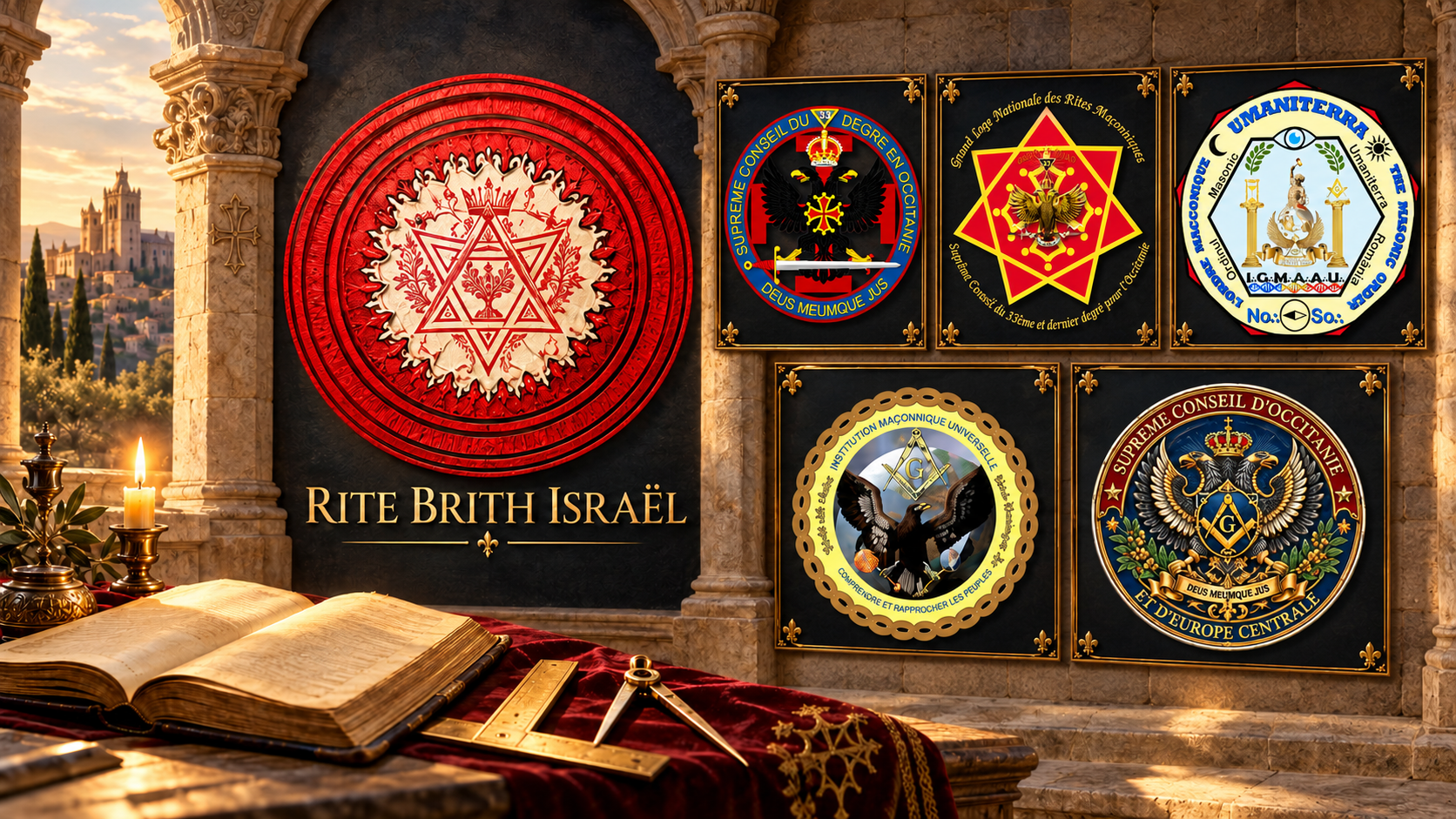
The connection with Brother Christian Belloc and the Suprême Conseil d’Occitanie is documented on the Rite’s official website. Its treaties page lists an agreement of friendship and recognition with the Supreme Council in Occitania, identifying Belloc as Sovereign Grand Commander. The same page records a recognition agreement with the Grande Loge Nationale des Rites Maçonniques, identifying Alain Herrera as Grand Master. (https://brith-israel.org/)
The Rite’s account also describes a personal connection: it states that Darmon received his thirty-third degree through the Supreme Council of Occitania before founding Brith Israël, and that he belongs to that Council. This personal history and the agreement between jurisdictions are distinct aspects of the relationship. Neither requires the Rite to surrender the institutional independence it expressly maintains. (https://brith-israel.org/)
Occitania’s own leadership page provides useful context. It identifies Christian Belloc as founder and Grand Maître ad vitam of the GLNRM, Sovereign Grand Commander of the Suprême Conseil d’Occitanie and president of the Institution Maçonnique Universelle. Alain Herrera is identified separately as the GLNRM’s serving Grand Master. (https://scdoccitanie.org/qui-sommes-nous)
For readers of the Suprême Conseil d’Occitanie et d’Europe Centrale, this relationship has particular relevance. Occitania’s website links both to Rite Brith Israël and to scec33.org, alongside the Suprême Conseil d’Occitanie et de Nouvelle France. These public references place the institutions within a shared field of fraternal contact. They should be understood with respect for each body’s own constitution and responsibilities; the listing alone does not establish a separate bilateral agreement between every organisation named. (https://scdoccitanie.org/qui-sommes-nous)
Fraternal cooperation benefits from this precision. Brothers can honour a connection without enlarging its meaning beyond what the parties have agreed. Different rites can meet, exchange knowledge and support one another while preserving their particular forms of work.
The founder also identifies affiliations with the Institution Maçonnique Universelle, or IMU, and the Fédération Maçonnique Internationale des Grades Supérieurs, or FMIGS. The Rite publishes corresponding entries on its treaties page. The IMU’s charter describes cooperation founded on respect for the autonomy of participating bodies. These relationships provide settings for exchange; their practical scope remains governed by the relevant agreements and the rules of the jurisdictions concerned. (https://brith-israel.org/ and https://institution-maconnique-universelle.webnode.fr/)
The distinction between public explanation and instruction within the Order is useful. Public writing allows readers to examine an institution’s ideas and intentions. Lodge work places responsibilities upon those who undertake its particular discipline. In both settings, clear authorship, careful teaching and consistency between declared principles and conduct matter.
The Rite also invokes the Seven-Point Rule of Initiatory Regularity. Its published account emphasises transmission, the practice of ritual, spiritual development and respect for the freedom and sovereignty of participating Masonic bodies. It presents this as its chosen framework, rather than a claim to recognition by every Masonic jurisdiction. (https://brith-israel.org/)
As a Brother, I welcome the opportunity to understand this undertaking through the explanations of its founder and the documents it makes available. Respect for Brother Mickaël Darmon’s work is best expressed through an accurate account of its purpose. Respect for Brother Christian Belloc and the institutions of Occitania likewise calls for clarity about the relationships they have established.
The enduring value of those relationships will be found in their practice: officers who teach conscientiously, members who honour their obligations and institutions capable of friendship without confusion of authority.
To Brother Mickaël Darmon and the Sisters and Brothers working within Rite Brith Israël, I extend my fraternal wishes for patience in building, fidelity in transmission and wisdom in the responsibilities ahead. May their exchanges with Occitania and other friendly jurisdictions sustain work worthy of the trust placed in them.
Sources and further reading
- Rite Brith Israël: Official website. https://brith-israel.org/
- Rite Brith Israël: Légitimité, filiation et vocabulaire.
- Rite Brith Israël: Treaties and institutional relationships.
- Suprême Conseil d’Occitanie: Leadership and institutional links. https://scdoccitanie.org/qui-sommes-nous
- Institution Maçonnique Universelle: Charter. https://institution-maconnique-universelle.webnode.fr/
- Suprême Conseil d’Occitanie et d’Europe Centrale. https://scec33.org/