Christian Belloc: Masonic Transmission, the Supreme Council of Occitanie and the Development of SCEC
Administrative representative and coordinator of the Suprême Conseil d’Occitanie et d’Europe Centrale
Author’s institutional connection: This review is written from within SCEC’s relationship of collaboration and recognition with the Supreme Council of Occitanie, represented by Christian Belloc. It presents an institutional perspective, with historical statements attributed to the records identified below.
Christian Belloc’s contribution to the Masonic institutions associated with Occitanie can be understood through the relationship between transmission, responsibility and fraternity. The institutional record describes a progression from lodge service and the establishment of new working bodies to the development of the Grande Loge Nationale des Rites Maçonniques, the Supreme Council of Occitanie and the Institution Maçonnique Universelle.
The official Supreme Council of Occitanie website identifies Belloc as founder and Grand Master ad vitam, Sovereign Grand Commander of the Supreme Council of Occitanie, and worldwide president of the Institution Maçonnique Universelle. It identifies Alain Herrera as Grand Master of the Grande Loge Nationale des Rites Maçonniques. These are distinct offices within related institutions. [1]
For the Suprême Conseil d’Occitanie et d’Europe Centrale, known through scec33.org as SCEC, Belloc’s role has a direct institutional significance. The Council’s constitution places its work within collaboration with the Supreme Council of Occitanie. The accompanying instrument provides for institutional, documentary and ritual support within agreed authorisations. Belloc represents Occitanie in that relationship as its Sovereign Grand Commander. SCEC’s own constitution governs its administration and collective decisions. [3][4]
The principal relationships can therefore be described precisely:
| Institution | Function described in the records | Belloc’s connection |
|---|---|---|
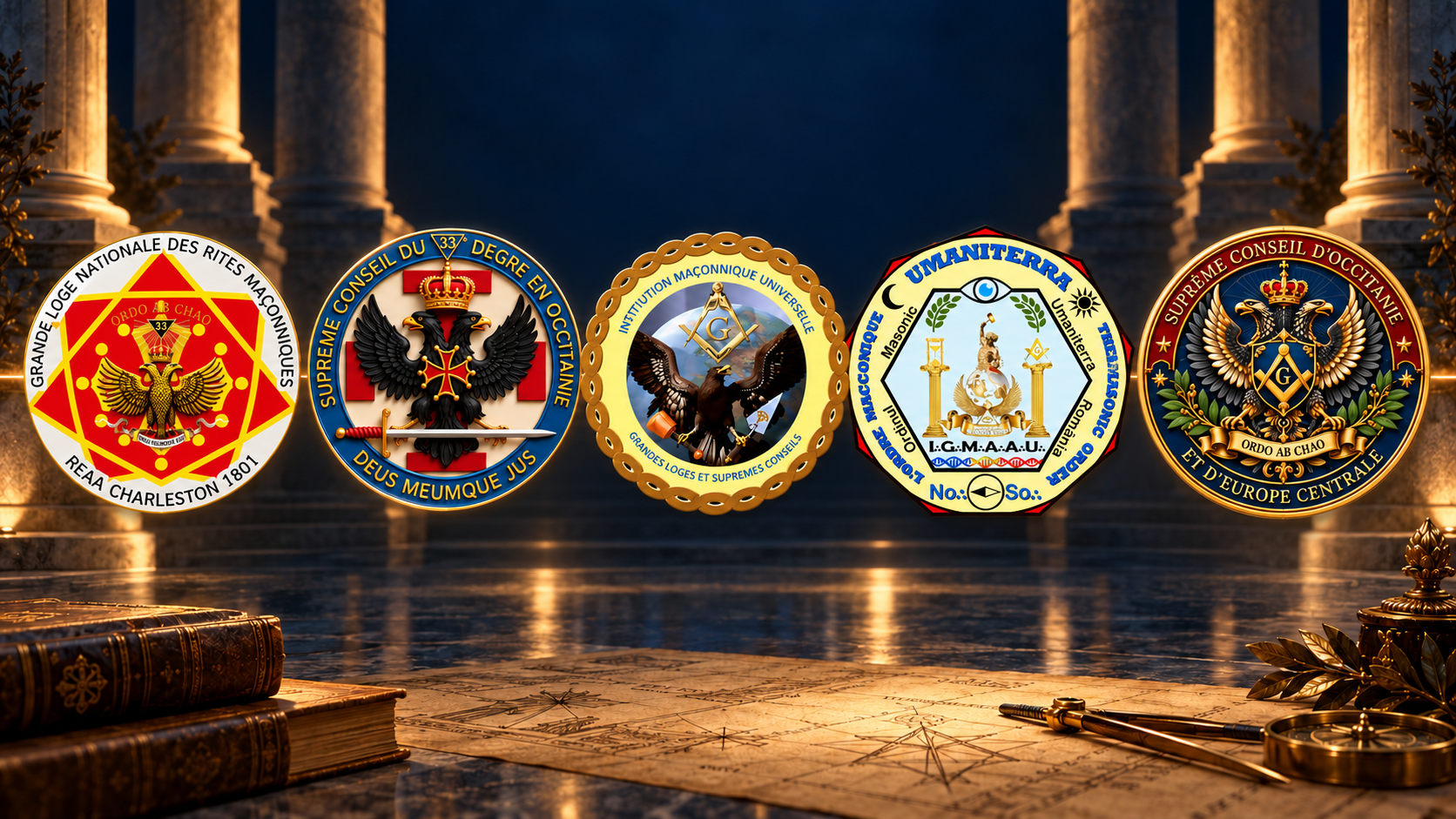
| Grande Loge Nationale des Rites Maçonniques, GLNRM | An obedience bringing together lodges and providing a framework for their work | Founder and Grand Master ad vitam; Alain Herrera is the current Grand Master |
| Supreme Council of Occitanie, SCDO | A body associated with the higher degrees, particularly the Ancient and Accepted Scottish Rite | Sovereign Grand Commander |
| Institution Maçonnique Universelle, IMU | An international framework for cooperation among Masonic bodies and traditions | Worldwide president |
| Suprême Conseil d’Occitanie et d’Europe Centrale, SCEC | A Council based in Bratislava, with Vienna as an additional meeting location, working within its agreed authorisations | Belloc represents the Supreme Council of Occitanie in the constitutive, recognition and collaboration framework |
This structure gives a concrete meaning to the respect owed to Belloc’s office. His authority in the SCEC relationship is understood through the institutional capacity in which he acts and the powers recorded in the applicable instruments. The relationship carries obligations of faithful transmission, accurate representation and responsible administration.
The 2026 institutional history places the beginning of Belloc’s Masonic journey at Le Flambeau, a lodge of the Grande Loge de France, on 6 March 1989. His curriculum vitae records advancement to the second degree on 1 July 1991 and to Master Mason on 7 June 1993.
It subsequently lists the fourth degree in 2006, the twelfth in 2009, the fourteenth in 2013, the eighteenth in 2018, the thirtieth in 2019 and the thirty third on 6 July 2020. These entries refer to different bodies at different stages of his development. They form the personal progression recorded in his curriculum vitae.
Belloc served several terms as Worshipful Master of Le Flambeau. The same record describes his involvement in founding and leading THOLUS, his participation in establishing the Ultreïa lodge of perfection, and his service as its secretary from 2014 to 2017. These responsibilities matter because they concern the ordinary work through which an institution survives: preparing meetings, maintaining records, supporting instruction and ensuring that successors receive what they need to continue.
His civilian biography presents a similarly sustained involvement in collective organisation. It records professional activity in hairdressing, representation of independent workers and entrepreneurs, training initiatives, publishing and civic work in Toulouse. Among the early milestones are Cléo Coiffure in 1972, the Village des Carmes association in 1974 and a training initiative for young hairdressers in 1976.
Later entries concern the Toulouse Chamber of Commerce, the Carmes district, the market and local transport questions. The record also describes editorial responsibilities associated with Le Tondu, Le Citoyen, Le Lien and Masonic publications. These activities provide context for a career in which the creation and maintenance of associations recur across different settings.
Four books are listed in the institutional biography: Les voies de la perfection maçonnique, L’inaccessible étoile, Le feu et la couronne and Le livre des rêves. Their presence in the record places writing and reflection alongside his administrative and ceremonial responsibilities.
The contemporary French Masonic project developed through a period of Romanian affiliation. According to the institutional history, a French initiative associated with the Grande Loge Nationale Roumaine 1880 took shape in 2020. The Pierre Brossolette lodge opened on 22 September that year.
The account cites Decree No. 69 of 1 February 2021 concerning a Supreme Council for Romania and Occitanie and Belloc’s appointment as Lieutenant Grand Commander for France. Decree No. 268 of 3 January 2022 concerns his appointment as Deputy Grand Master for France of GLNR 1880. Decree No. 81 of 28 February 2022 is associated with a National Council for France.
These are specific references in the institutional narrative. The supplied history does not reproduce the underlying decrees, so their contents are described here as that history records them.
The expansion of working bodies followed. The document names the Jean Moulin lodge of perfection, the Fernand de Magellan chapter and the Molière areopagus. Hervé Lyautey, Guy Reynes and Antoine Blatche appear in connection with their leadership. Jean-Pierre Lamon and Serge Bastiani are identified among those appointed to the thirty third degree in 2022.
The narrative dates the separation from the Romanian obedience and formation of GLNRM to 2022; Belloc’s accompanying curriculum vitae gives 2023 for his founding roles in GLNRM and the Supreme Council of Occitanie. The distinction between those dates remains unexplained in the supplied record. What it consistently describes is a transition from Romanian affiliation to the establishment of the contemporary French bodies.
The reference to Romanian traditions reaching back to 1880 belongs to the account of historical origin. The modern French foundation has its own chronology. Maintaining that distinction respects the integrity of both histories and allows questions of transmission and recognition to be examined through the instruments relevant to each institution.
The document identifies L’HYPOGÉE, registration number W313034172, as the managing association of GLNRM and the Supreme Council of Occitanie. It records a convention on 29 June 2024 attended by approximately 150 participants, followed by a leadership transition at Toulouse on 25 November 2025.
At the latter convention, according to the history, Alain Herrera succeeded Belloc as Grand Master of GLNRM. Belloc retained his honorary position as Grand Master for life and his responsibilities in the Supreme Council of Occitanie and IMU. The current official leadership page reflects that distribution of offices. [1]
A transition of this kind is an important part of institutional continuity. It gives another person responsibility for the next stage of the work while preserving access to the founder’s experience. The account presents Herrera’s leadership as continuing the obedience’s spiritual commitments and its engagement with contemporary life.
Those commitments are expressed most clearly in the manifesto. It invokes the Grand Architect of the Universe and describes a spiritual approach rooted in Judeo-Christian traditions, with express references to Protestant and Orthodox traditions. It associates initiation with self-examination, fraternity, compassion, freedom, human dignity and peace.
The manifesto also states that work with symbols and philosophy should influence daily conduct. This is the principle through which its treatment of ritual becomes most intelligible. A ceremonial undertaking acquires moral weight when it changes the care with which a person speaks, decides, honours an obligation or responds to another person’s vulnerability.
Ritual requires preparation and attention. Its forms create occasions for listening, recollection and reflection. Within the approach described in the manifesto, repetition can deepen understanding because the participant returns to the same material with a different measure of experience and responsibility.
Respect for the rite therefore includes respect for its transmission. It requires attention to the authorised text, the competence of those conducting the work, the preparation of participants and the circumstances in which a ceremony may properly take place. These concerns later appear in concrete form in SCEC’s constitutional provisions.
The oath of the Masonic knight included in the history places diligence, generosity, justice, freedom and protection of the vulnerable among its obligations. Its language extends the consequences of commitment beyond the Temple. The ethical question is what these duties require when they become inconvenient, costly or difficult to reconcile with personal preference.
The manifesto also distinguishes the inward experience of initiation from the privacy of membership. Initiatic experience cannot be fully transferred through explanation alone. Membership information, meanwhile, concerns another person’s confidence and security. The distinction gives discretion a human purpose and calls for careful judgement in what is disclosed.
GLNRM’s stated openness has its own defined setting. The document welcomes visiting Sisters and Brothers from different obediences and describes mixed participation and cooperation across rites. It also specifies adherence to its spiritual traditions as a prerequisite. Hospitality, membership and institutional cooperation must consequently be understood according to their respective conditions.
The international initiative associated with Belloc takes cooperation further. The institutional history locates the development of IMU in 2024 and identifies Jean-Noël Raynaud and Augustina Raynaud as central contributors alongside him. Its stated purpose is to overcome barriers of distance, language and custom through practical fraternity.
The IMU website describes philosophical and spiritual conferences, documentary resources, ethical reflection, study of rituals through video discussion, and philanthropic or humanitarian activity. It welcomes male, female and mixed obediences practising different rites and presents cooperation with existing unions as part of its approach. [2]
The history reports approximately 300 participating obediences and Supreme Councils in its account of 2025, and more than 330 obediences in a later passage. These are institutional figures; the document does not provide a complete dated membership register. They describe the scale claimed for the initiative, while its enduring contribution will be expressed through the actual work of participating bodies.
The Toulouse gathering of 16 and 17 October 2026 provided the setting for a fuller declaration of purpose. According to the institutional history, Belloc proclaimed the Toulouse Declaration on 17 October during IMU’s consecration.
The declaration affirms dignity, freedom of conscience, equality, active fraternity and justice. It rejects discrimination and domination, recognises diversity among initiatic traditions and commits participants to dialogue and peace. It also addresses responsibility toward the Earth, future generations and the wider living world.
Its description of IMU contains a particularly clear undertaking:
“Elle est un pont, non un pouvoir ; une source, non un sommet ; un service, non une autorité.”
“It is a bridge, not a power; a source, not a summit; a service, not an authority.”
The importance of that passage lies in the standard it sets for cooperation. An international meeting place serves its participants when it enables them to study, communicate and undertake useful work while understanding one another’s responsibilities.
For SCEC, these wider principles acquire a specific institutional expression. Its constitution comprises 33 articles, two schedules and operating rules. The associated instrument of constitution, recognition and collaboration is dated 27 October 2026; the available execution copy records Belloc’s signature dated 28 October 2026. The instrument adopts the constitution and defines the relationship between the two Councils. [3][4]
The agreed framework places SCEC’s authorised Masonic work within collaboration with the Supreme Council of Occitanie. Occitanie provides institutional, documentary and ritual support within the agreed authorisations. Belloc’s role in that framework derives from his office as Sovereign Grand Commander and his representation of the issuing body.
SCEC retains responsibility for its daily administration and governs itself under its constitution within the powers received. Its principal seat is Bratislava, with Vienna designated as an additional meeting location. Ritual work at either location remains subject to the applicable permissions concerning premises, participants, officiants and forms of work.
My role, as described in the instrument, is administrative representation and coordination in dealings with Christian Belloc and the relevant institutional contacts, under the Council’s decisions. Masonic offices are determined by the appointment or election records. Keeping these responsibilities clear is part of the respect owed to the Council and to the authority through which its work is supported.
The constitution specifies nine authorised active seats and a quorum of six eligible active members. It sets procedures for admission, elections, succession, financial decisions, disciplinary matters and constitutional amendments. These provisions describe the authorised governance structure; they do not, by themselves, establish how many seats are occupied at a particular moment.
Its treatment of ritual is equally precise. The approved framework determines the degrees, texts, officiants, diplomas, places and procedures that may be used. The constitution distinguishes personal possession of a degree from authority to confer it, and the thirty third degree from active membership of the governing Council. It also preserves the competence of symbolic lodges and Grand Lodges over the first three degrees.
These distinctions make responsibility traceable. They allow a member to understand which body has authorised a particular activity, which officer is competent to perform it and which record preserves the decision. In this setting, reverence for tradition is expressed partly through the care taken to document its transmission.
The constitution also gives practical form to ethical commitments. It requires financial oversight, disclosure of relevant interests, impartial handling of complaints and protection of confidential records. Membership and office provide no entitlement to commercial preference, political influence or private financial advantage. Contributions cannot purchase admission, rank or recognition.
Such provisions are worth examining as part of the Masonic project itself. A commitment to justice has practical consequences for how a complaint is heard. Fraternity has consequences for how assistance is provided. Fidelity has consequences for the preservation of records and the transfer of responsibilities to a successor.
Recognition is described with the same precision. The instrument establishes the agreed relationship between Occitanie and SCEC. Recognition by other bodies and admission to IMU require their respective decisions. SCEC’s name and its meeting locations do not establish exclusive jurisdiction over Central Europe. This defined scope gives its public account a documentary basis.
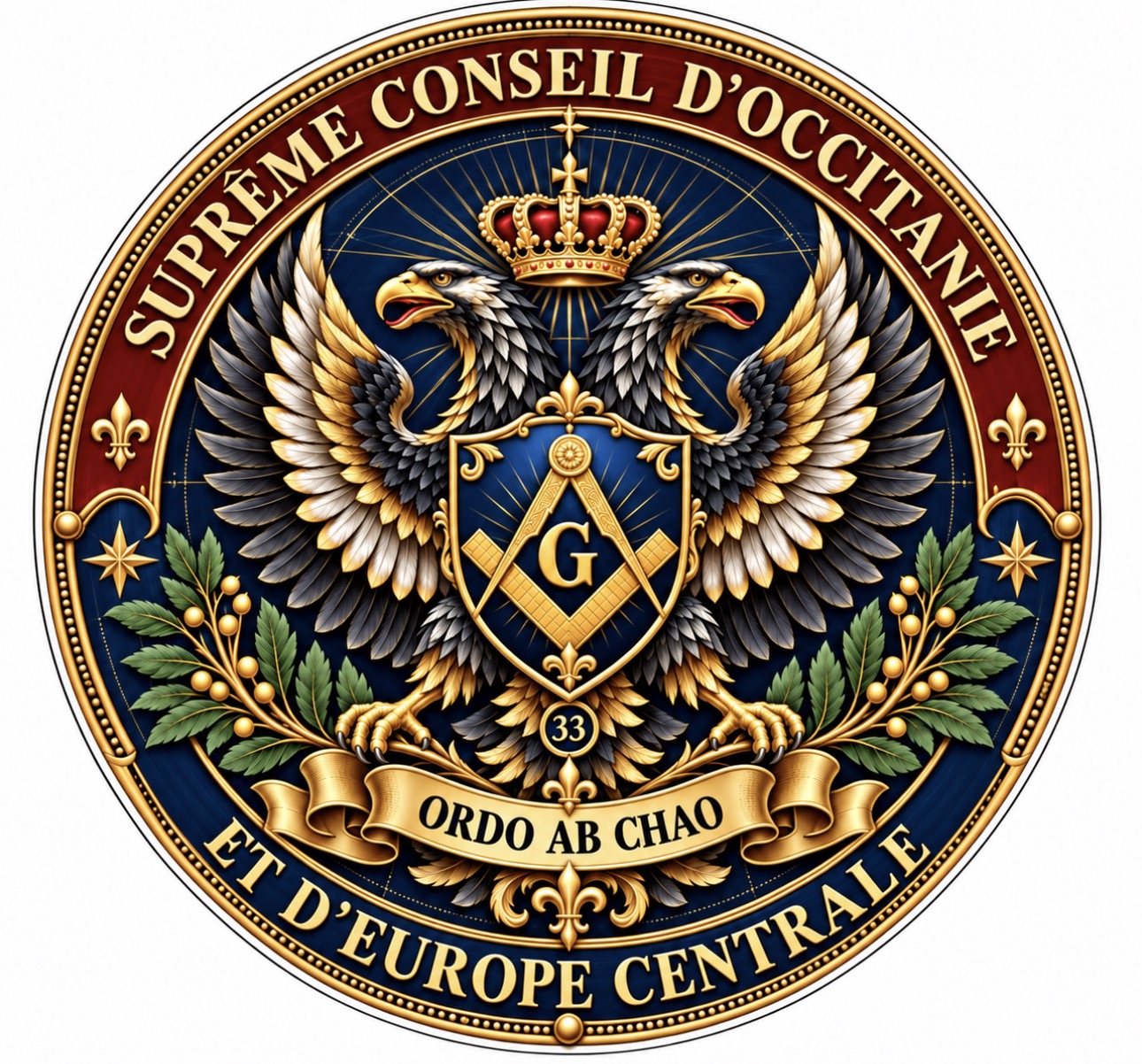
The symbolism of SCEC’s emblem is also explained in the constitution. Article 30 assigns the two heads of the eagle an attention to inheritance and the future. The square and compasses centre the composition on measure and judgement. The number 33 identifies the Scottish Rite context. These are the meanings adopted for this particular emblem.
Read alongside Belloc’s institutional history, the emblem offers a useful interpretation of transmission: the responsibility to understand what has been received and to prepare carefully for what follows. Its significance depends on the conduct associated with it.
The official Supreme Council of Occitanie website links to SCEC under the name Suprême Conseil d’Occitanie et d’Europe Centrale. That public reference accompanies the documentary relationship described in the constitution and recognition instrument. [1]
From SCEC’s perspective, respect for Christian Belloc rests on both his recorded contribution and the responsibility attached to the present relationship. His work has brought together lodge experience, institution building, writing, leadership succession and an international declaration of fraternity. The record provides substantial material for understanding those commitments in their own institutional setting.
The responsibility of those continuing the work is correspondingly concrete: to preserve the rite with care, exercise only the powers entrusted to them, keep accurate records, honour the dignity of others and prepare successors capable of carrying those obligations forward.
That is the form of appreciation I consider most faithful to Belloc’s undertaking. Gratitude becomes meaningful when it is expressed through the quality of the work that follows.
Sources and documentary basis
- Supreme Council of Occitanie: leadership and institutional connections. https://scdoccitanie.org/qui-sommes-nous
- Institution Maçonnique Universelle: official website. https://institution-maconnique-universelle.webnode.fr/
- SCEC: institutional website. https://scec33.org/ Documentary source: Constitution of the Suprême Conseil d’Occitanie et d’Europe Centrale, edition dated 27 October 2026, public edition consulted; especially Articles 1 to 7, 10 to 24, 29 to 33 and Schedules A and B.
- Acte de constitution, de reconnaissance et de collaboration / Instrument of constitution, recognition and collaboration, dated 27 October 2026; available copy bearing Christian Belloc’s dated signature of 28 October 2026.
- HISTORIQUE GLNRM 2026, including its manifesto, institutional narrative, Toulouse Declaration and Christian Belloc’s curriculum vitae.
Historical dates, appointments and participation figures are attributed to the institutional records cited. The interpretive assessments express the perspective proposed in this review.