Masonic Symbols Explained: Meanings, History and Common Questions
What can a Masonic symbol tell us, and what cannot be read from an image alone? A sourced guide to familiar emblems and the questions they invite.
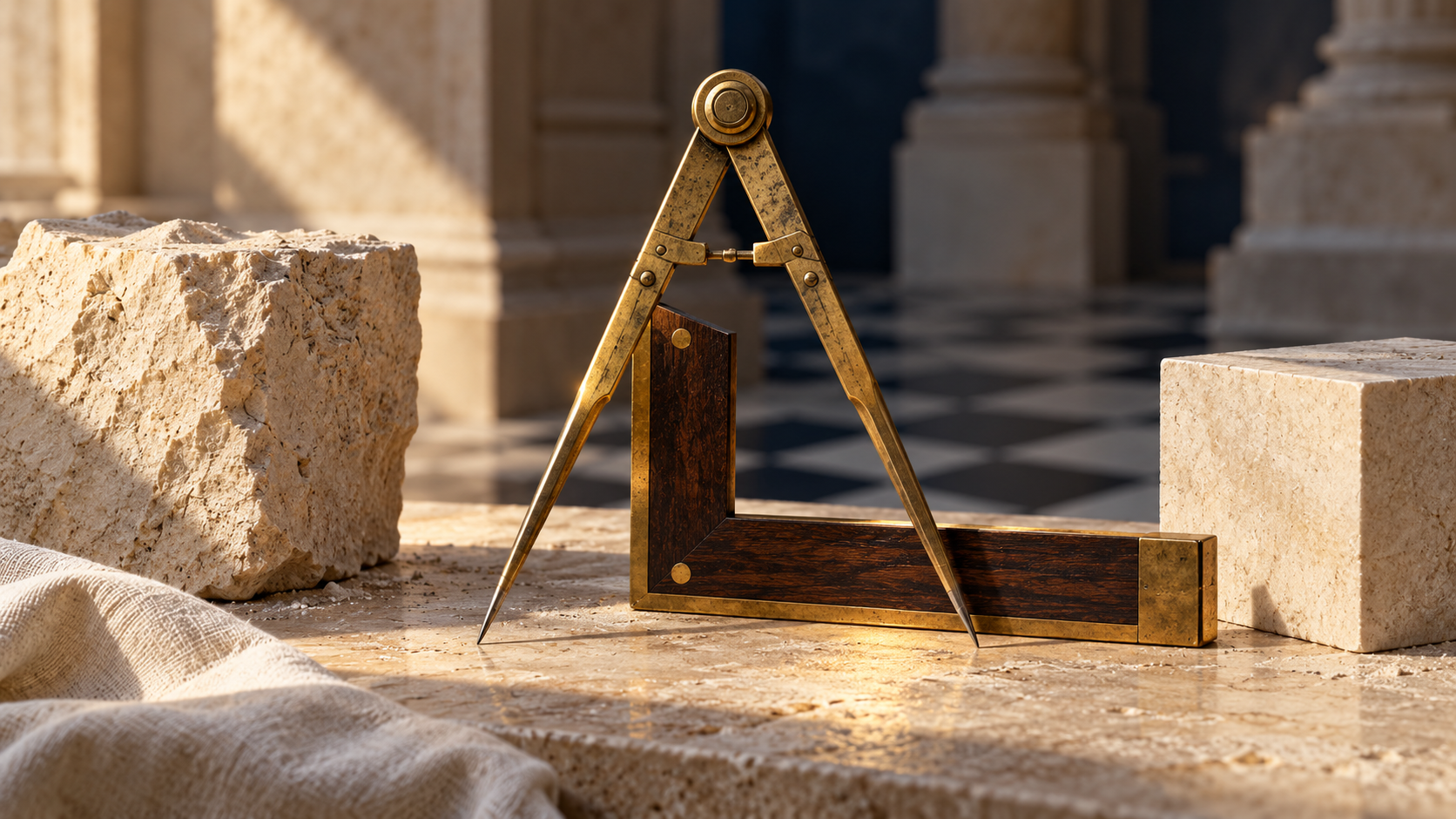
Masonic symbols use builders’ tools and other familiar images to explore conduct and responsibility. Their interpretation depends on the ritual and tradition in which they appear. 1
A square on a ring is easy to notice. The harder question is what its wearer does when a fair decision becomes inconvenient. This guide approaches symbolism through that practical question. It draws on public institutional and museum sources, then offers reflections that readers can test against ordinary life.
How should a Masonic symbol be read?
Begin with three distinctions: what can be seen, what a source documents, and what a reader interprets. A description identifies the object. A historical claim needs evidence. A philosophical reading proposes a way of thinking.
Keeping those tasks separate allows a symbol to remain suggestive without turning suggestion into fact. An eagle on an old building cannot, by appearance alone, establish the building’s Masonic history. Nor does a modern explanation automatically describe what an earlier maker intended.
The practical reflections in this article are offered in that spirit. They are not presented as a ritual prescribed for every lodge.
What do the square and compasses mean?
The square commonly represents honesty and fair conduct. The Grand Lodge of Pennsylvania explains it through the obligation to act truthfully towards others. 2
The compasses commonly represent restraint and the limits a person places on desire. This is the reading given by the Grand Lodge of Ohio. 3
Together, they invite two different examinations. Have I treated someone fairly? Have I controlled the appetite, impatience or ambition influencing my decision? A person may know a principle perfectly and still need to practise it under pressure.
Consider a disagreement in which you hold the stronger position. The square asks whether your demand is just. The compasses ask whether you can stop when justice has been served. That is one practical reading of the tools, not a claim about a hidden universal code.
What does the letter G mean in Freemasonry?
Geometry is a central documented meaning of the letter G. London’s Museum of Freemasonry emphasises this historical reading. 4 The Scottish Rite’s Northern Masonic Jurisdiction also explains G through God or the Great Architect of the Universe. 5
These accounts should be attributed to their sources rather than compressed into a single compulsory definition. Before explaining a particular emblem, establish where it was made and how the relevant tradition describes it.
Geometry offers a useful starting point for reflection: a measurement does not improve because its result flatters us. Applied to conduct, that thought asks for an honest standard, especially when we are judging ourselves.
What do the rough and finished stones represent?
The rough ashlar and the perfect ashlar are Masonic images of personal development, represented by an unworked stone and a prepared one. 6
The question they suggest is concrete: which habit needs attention? It might be interrupting others, postponing an apology or allowing pride to settle an argument before the evidence has been heard.
One modest change, sustained, gives that reflection substance. A stone cannot be shaped by admiration for the tools. Equally, an account of one’s ideals is incomplete until it becomes possible to name something one has actually changed.
Why do Freemasons wear aprons?
The Masonic apron developed from a craftsman’s protective garment. Museum examples show how colours and decoration came to identify degrees and responsibilities. 7
Its connection with work offers a quiet corrective to the wish to be admired. An apron belongs to someone who has something to do. Read in that way, ceremonial clothing can remind its wearer of a task still unfinished.
For an unfamiliar apron, consult the institution or collection that identifies it. Avoid assigning a rank from colour alone, without the relevant context.
What does the black and white floor mean?
The chequered pavement is commonly read as an image of the contrasting conditions of human life. Maine’s published Masonic handbook discusses it through good and evil. 8
A useful question follows: can I preserve the same standards when circumstances change? Generosity during abundance and patience during disappointment ask different things of a person.
The pattern can therefore prompt reflection on consistency. It need not become a scheme for sorting people into two opposing kinds. A considered interpretation should leave room for the complexity of a life and the possibility of correcting a mistake.
Is the eye above a pyramid a Masonic symbol?
The all-seeing eye has Masonic uses. However, the Southern Jurisdiction of the Scottish Rite explicitly distinguishes it from the Great Seal of the United States, which it does not identify as a Masonic emblem. 9
An eye, a triangle and an eye above a pyramid should not be treated as interchangeable evidence. Examine the particular object and the explanation attached to it.
This is a useful test of intellectual discipline. When an image seems to confirm a dramatic theory, ask what evidence would still be needed. Visual resemblance can start an investigation; it cannot finish one.
Why does the Scottish Rite use an eagle with two heads?
The Scottish Rite uses a double-headed eagle, an emblem older than Freemasonry. The Northern Masonic Jurisdiction also uses it for the 32nd degree. 10
In that jurisdiction, the 33rd degree recognises distinguished service. Its rules should not be assumed to govern every Supreme Council. 11
As a philosophical reading, two directions of attention can suggest a useful discipline: looking closely at one’s convictions while remaining attentive to the person standing opposite. That interpretation is offered here, not asserted as the eagle’s single official meaning.
A Council’s emblem identifies the body using it. Its authority and institutional relationships must be established through its actual records, not inferred from the number of heads, crowns or wings.
What does Ordo ab Chao mean?
Ordo ab Chao means order from chaos. The Scottish Rite Southern Jurisdiction’s educational material connects the motto with its foundational Circular Throughout the Two Hemispheres. 12
For personal reflection, order can begin with distinguishing a fact from an assumption, keeping a promise, or settling a neglected responsibility. These are ordinary acts, but they give the motto a demanding application. An orderly explanation of one’s principles is easier to produce than an orderly response when those principles are tested.
How does this approach relate to Occitania?
Occitania describes its path through spiritual development, fraternity and symbolism, within a Judeo-Christian and chivalric orientation. 13
That educational emphasis provides the context for this contribution on the website of the Suprême Conseil d’Occitanie et d’Europe Centrale. The comparisons with other traditions are included to clarify the subject. They do not change the Council’s constitution, admission conditions or ritual practice.
A useful reading of a symbol should return us to something we can examine: a judgement, a relationship, a responsibility. The image may stay the same for years. Our willingness to answer the question it raises need not.
Further questions
Can I study Masonic symbolism without being a member?
Yes. The museum and institutional publications cited here are publicly available. They provide a starting point for historical study and comparison; reading them is distinct from participating in a lodge’s initiatory work.
Does a Masonic ring prove membership or rank?
A ring alone is insufficient evidence. If membership or office matters, seek confirmation from the relevant institution through an appropriate channel. A photograph establishes the presence of an object, not the current status of its wearer.
How can I check a claim about an old Masonic object?
Look for a dated catalogue record, provenance, an archival document or a responsible institution’s description. Separate a contemporary record from a later interpretation. When evidence is absent, leave the question open instead of turning a plausible story into a certainty.
Where should a beginner start?
Choose one symbol. Identify the object, read a reliable explanation, and ask what practical question it raises. Return to it after reflection. A small number of well-understood examples is a sound basis for further study.
Sources and further reading
The sources below document particular traditions and objects. Citing an institution does not imply affiliation, mutual recognition or its endorsement of this article.
- Freemasonry symbols · Masons of California
- The square and compasses · Grand Lodge of Pennsylvania
- The square and compasses: restraint · Grand Lodge of Ohio
- What does the G stand for? · Museum of Freemasonry, London
- The origins of the square and compasses · Scottish Rite, Northern Masonic Jurisdiction
- The rough and perfect ashlars · Grand Lodge of Ohio
- Why do Freemasons wear aprons? · Scottish Rite Masonic Museum & Library
- Handbook: symbolism of the degrees · Grand Lodge of Maine
- Is the eye in the pyramid a Masonic symbol? · Scottish Rite, Southern Jurisdiction
- The origins of the eagle with two heads · Scottish Rite, Northern Masonic Jurisdiction
- What is a 33rd degree Mason? · Scottish Rite, Northern Masonic Jurisdiction
- The Circular Throughout the Two Hemispheres · Scottish Rite, Southern Jurisdiction, Master Craftsman Online College
- Public presentation of the institution · Suprême Conseil d’Occitanie